Validation
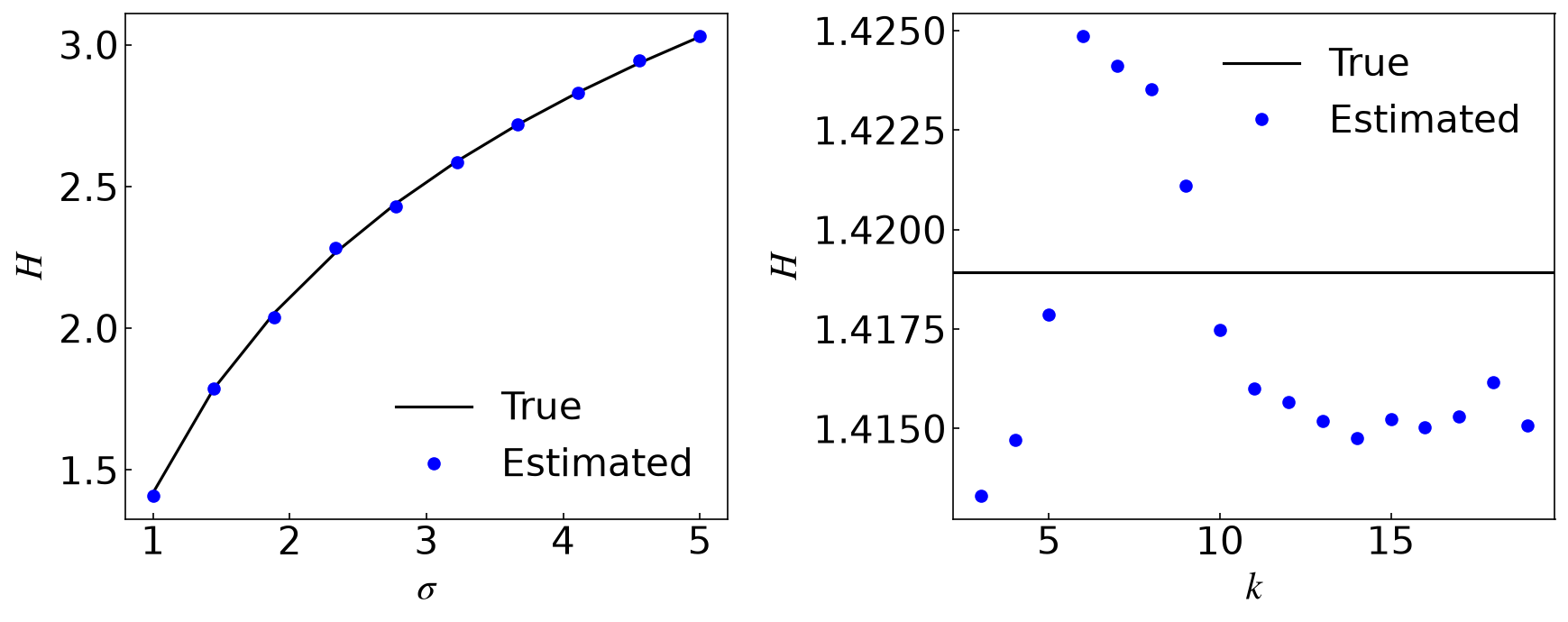
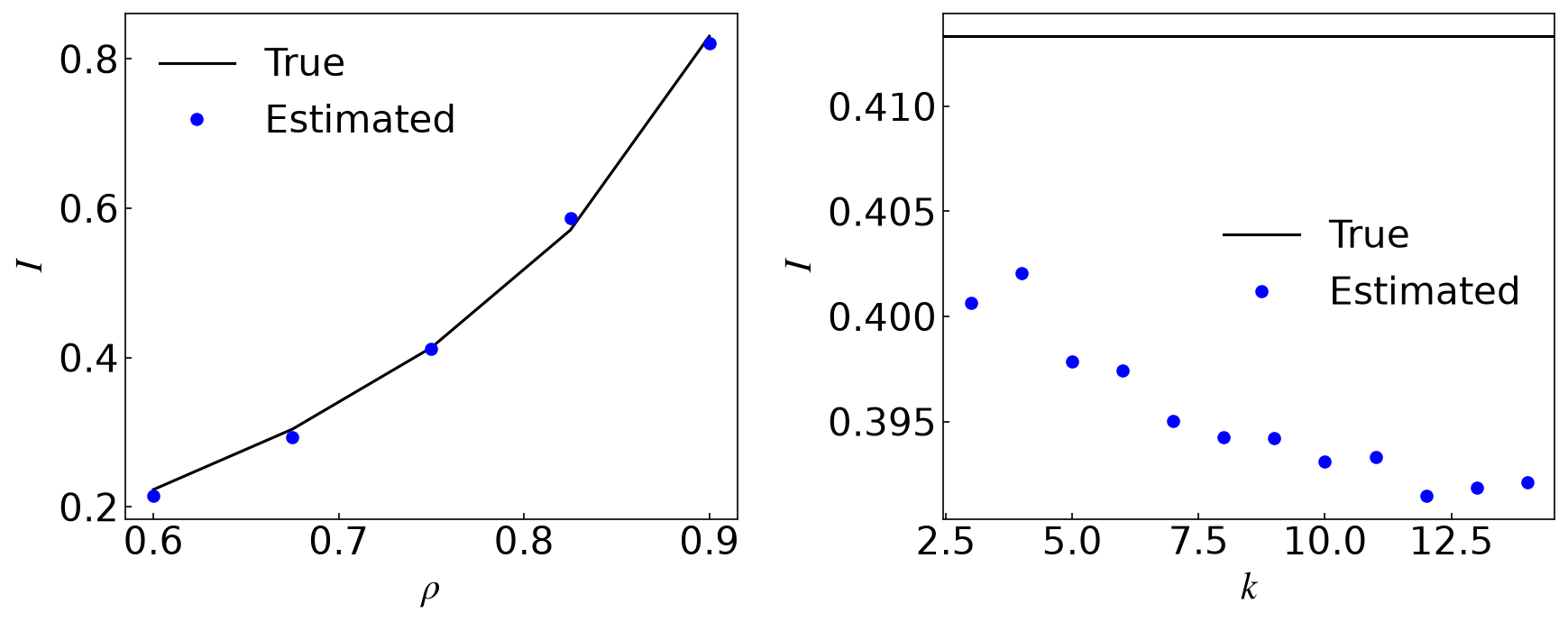
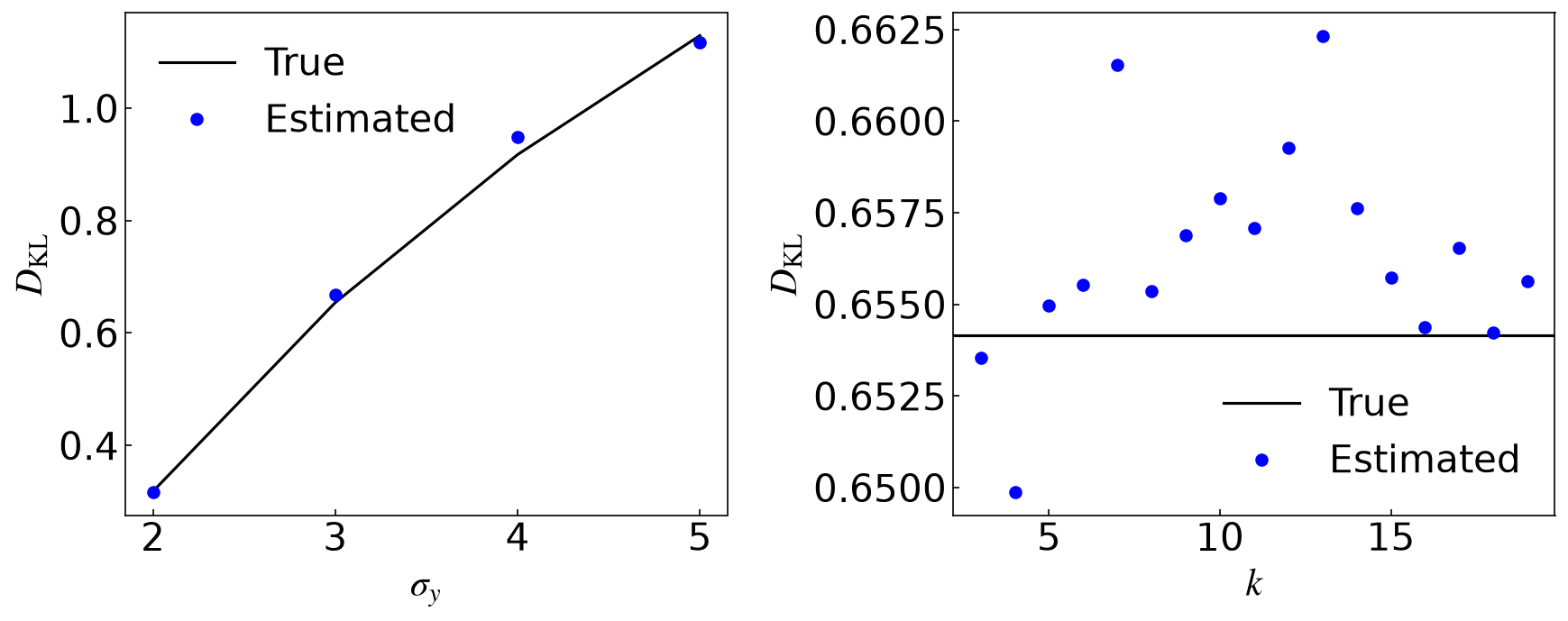
Each estimator is validated against analytical results on synthetic Gaussian data. Black lines show theoretical values; colored markers show KNN estimates (N = 5,000–10,000 samples, k = 5 unless varied).
Shannon Entropy
Left: Entropy of a Gaussian \(X \sim \mathcal{N}(0, \sigma^2)\) vs standard deviation \(\sigma\). The theoretical value is \(H = \tfrac{1}{2}(1 + \ln 2\pi\sigma^2)\).
Right: Estimated entropy vs KNN parameter \(k\) at fixed \(\sigma = 1\).
Mutual Information
Left: Mutual information of a bivariate Gaussian with correlation \(\rho\) vs \(\rho\). The theoretical value is \(I = -\tfrac{1}{2}\ln(1 - \rho^2)\).
Right: Estimated MI vs \(k\) at fixed \(\rho = 0.75\).
KL Divergence
Left: KL divergence \(D_{\rm KL}(\mathcal{N}(0,1) \| \mathcal{N}(0,\sigma_y^2))\) vs \(\sigma_y\). The analytical value is \(D_{\rm KL} = \ln\sigma_y + \tfrac{1}{2\sigma_y^2} - \tfrac{1}{2}\).
Right: Estimated \(D_{\rm KL}\) vs \(k\) at fixed \(\sigma_y = 3\).
Transfer Entropy
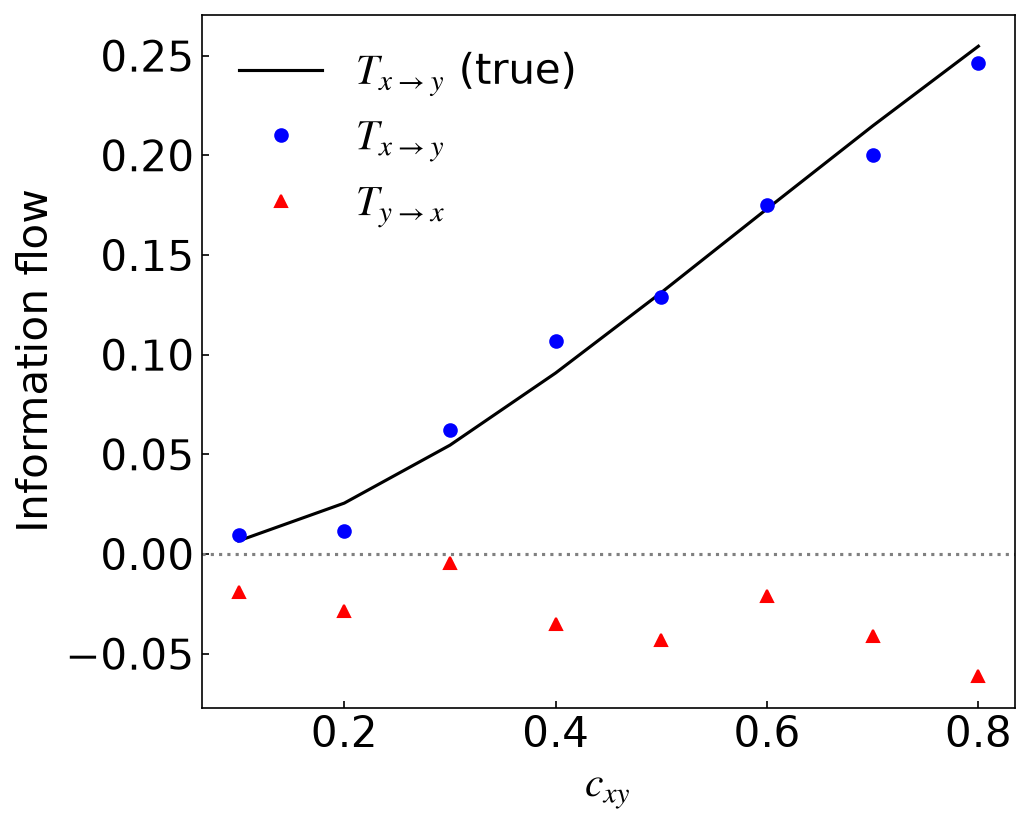
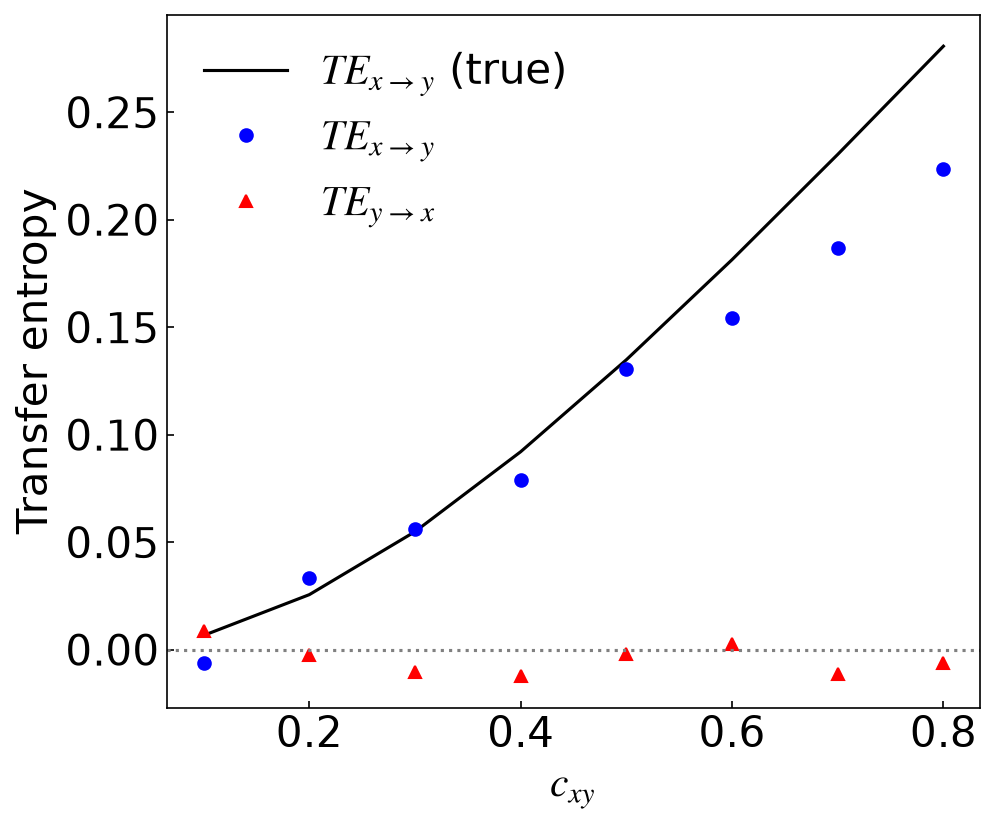
Coupled linear Gaussian AR system where \(x\) drives \(y\):
with \(a = b = 0.5\) and \(\varepsilon \sim \mathcal{N}(0, 1)\). The causal direction is \(x \to y\); \(c_{xy}\) controls coupling strength.
Blue circles show \(TE_{x\to y}\) (should exceed the black analytical line); red triangles show \(TE_{y\to x}\) (should remain near zero). The estimator correctly identifies the causal direction and is monotone in coupling strength.
Information Flow
Same coupled AR system as above.
Blue circles show \(T_{x\to y}\) (Horowitz–Esposito information flow in the causal direction); red triangles show \(T_{y\to x}\) (should remain near zero). The estimator recovers the correct causal asymmetry across all coupling strengths.